What does AI really change in event strategy?
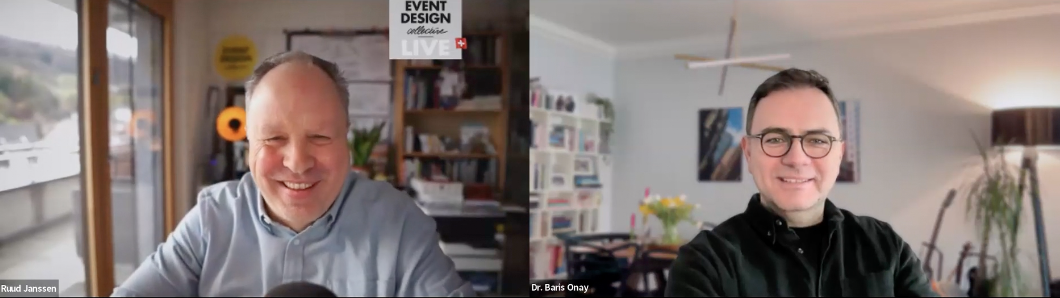
I recently joined EDCO’s (Event Design Collective) DESIGN to CHANGE podcast with Ruud Janssen for a conversation that started with “AI in event design” and quickly became something more useful: how strategy actually gets made under uncertainty (and why most event tech conversations still miss the point).
EDCO has earned its place as one of the most credible voices in event design by doing what our industry rarely does: standardising the strategic language. The Event Canvas methodology is built around stakeholders and intended behaviour change, and it is backed by a serious training and certification ecosystem.
The core point: AI doesn’t replace strategy, but it compresses the first mile into a centimetre!
Most “strategy” in events starts the same way:
Opens a spreadsheet -> Googles competitors -> Starts gathering data -> nothing is standardised -> tries to remember what happened last year -> produces a deck -> Everyone has an idea what should be in it -> scope creep -> the base research takes weeks -> something needs to give -> a meeting happens without much of an agenda -> box ticked -> back to BAU
AI changes this if you apply it as a synthesis engine, not a content generator. I describe the shift like this: From handcrafted research (slow, inconsistent, expensive) to standardised synthesis (fast, comparable, repeatable), leaving time for real strategy work.
That’s the logic behind the Event Strategy Bot: generate a structured strategy view of an event “in minutes, not months”, using public information, so you can spend human time where it belongs: making choices and building capability.
My practical rules for using LLMs in event strategy
1) Guardrails beat instructions
One of my biggest learnings building these tools: telling the model what to do is useful; telling it what not to do is essential. Guardrails stop the model from “helpfully” wandering into irrelevant territory and keep outputs decision-grade.
2) Context first, questions later
If you want higher-fidelity answers, don’t start with questions. Start with synthesis: build the knowledge base, then interrogate it. The quality difference is material. This is true whether you’re analysing a trade show, a conference, or something politically charged like Davos.
3) Anchor everything in intended outcomes and behaviour change
This is where EDCO’s world and mine align neatly: the Event Canvas approach explicitly frames events around stakeholders and behaviour change, and that’s exactly how technology becomes value.
The real takeaway from the podcast
In my opinion, the strongest line from the episode description is also the most operationally true:
Tools follow strategy, not the other way around.
AI is a force multiplier. If you point it at clarity, it gives you speed-to-decision. If you point it at ambiguity, it gives you prettier ambiguity. And that’s the bar I care about: does this help an event leader make a better decision on Monday morning?
Try the Event Strategy Bot and decide for yourself.