The Event-Led Growth Bot: Build a B2B Event Marketing Strategy in Minutes
Event-Led growth is a B2B go-to-market strategy that uses events as a repeatable engine for pipeline, trust, customer expansion and market leadership.
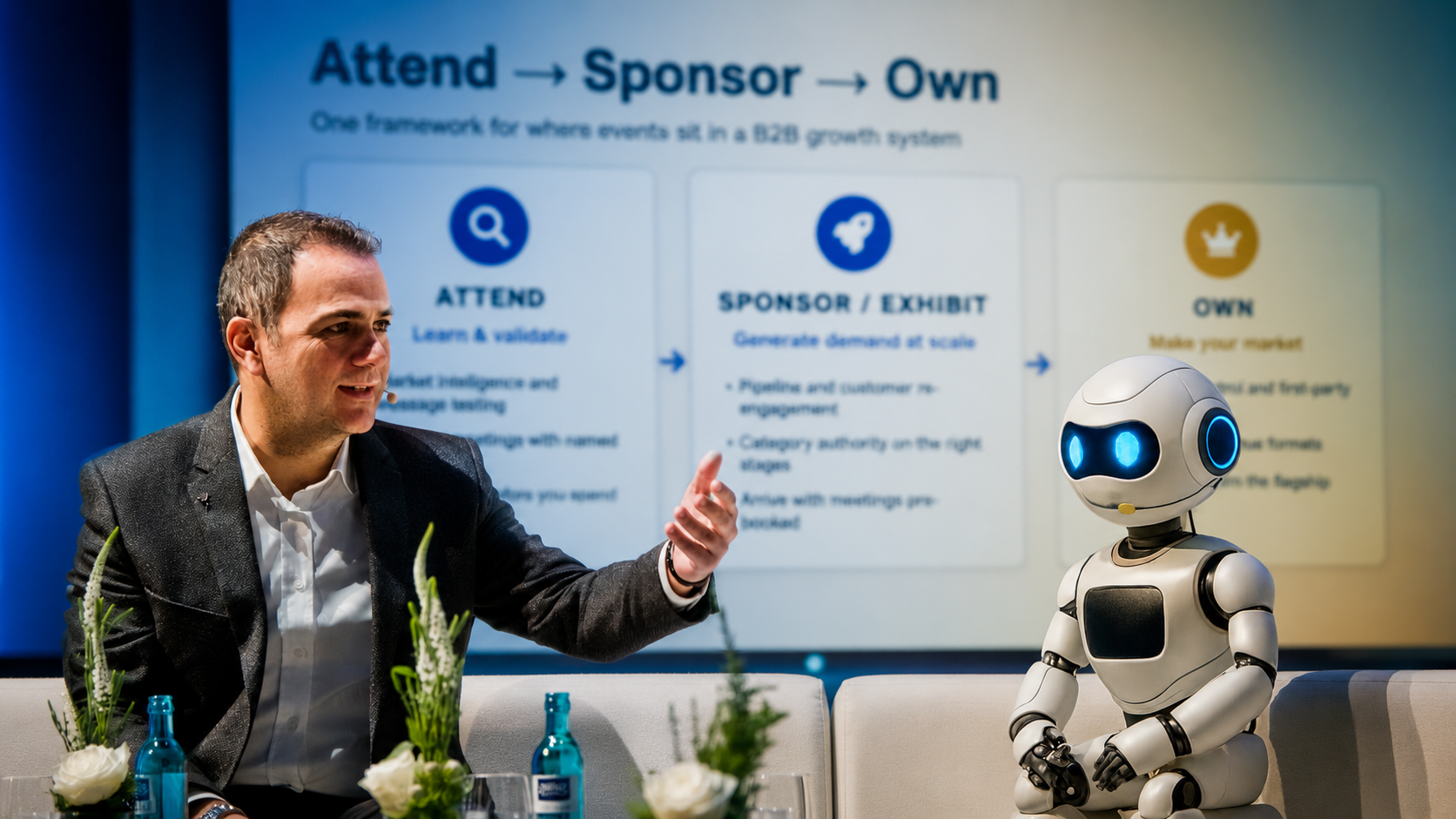
The Event-Led Growth Bot helps you turn that idea into a practical strategy using my Attend → Sponsor → Own framework: which events to attend, when to sponsor or exhibit, and when to build your own events. Using the Bot, you’ll get a practical roadmap to align sales and marketing around the right audiences and turn events into a measurable pipeline, without weeks of research.
What is Event-Led Growth?
Event-Led Growth (ELG) is the shift from treating events as isolated marketing activities to placing them at the beating heart of a company’s growth system. In a strong ELG model, events are connected to sales, marketing, content, ABM, customer expansion, and first-party data. The Event-Led Growth Bot follows my Attend → Sponsor → Own (ASO) framework, connecting each buyer moment to your content, sales, and marketing efforts, consistently creating a high-quality, validated pipeline.
The ASO framework: Attend → Sponsor/Exhibit → Own
1) Attend: Learn and Validate
Use attendance to gather market intelligence, test messaging, map competitors, and run targeted meetings. Score events on audience fit, speaker quality, organiser credibility, competitor presence, and meeting potential.
2) Sponsor/Exhibit: Generate demand at scale and meet your market
After validation, invest to generate pipeline, re-engage customers, expand reach, and demonstrate expertise. Measure success through meetings, net-new pipeline, brand exposure, and long-term tracking of closed deals.
3) Own/Organise: Lead category and make your market
Build your own platforms to control the narrative, grow first-party data, and create recurring revenue. Start small with roundtables, workshops, or webinars, then expand to a flagship event. Ownership is a portfolio, not a single show: think webinars, city tours, labs, customer councils, and an annual summit.
-
No. Event-led growth is a system, not a bigger events calendar. The Attend → Sponsor → Own framework integrates events with ABM, sales and content, and measures them like performance marketing. Most companies following it end up doing fewer events, chosen more deliberately, with each one tied to pipeline, relationships or first-party data rather than attendance for its own sake.
-
Score every candidate event on five criteria: audience fit, speaker quality, organiser credibility, competitor presence and meeting potential. Commit budget only when an event scores well against your ICP and there is a realistic path to booked meetings. The Event-Led Growth Bot runs this scoring logic for you based on your market, regions and goals.
-
Ideally, sponsor or exhibit after a successful Attend pilot has validated the audience. Enter with pre-arranged meetings, booth activations and content slots tied to defined commercial outcomes: net-new pipeline, customer re-engagement and brand positioning, rather than buying a booth and hoping. Measure the investment on meetings held, pipeline created and deals closed over the following twelve months.
-
Event marketing focuses on promoting and delivering individual events. Event-led growth is a multi-event, multi-engagement programme that connects events to a business's broader commercial goals: pipeline, customer expansion, first-party data and market positioning. In an event-led growth model, each event is one node in a system rather than a standalone campaign.
-
Attend → Sponsor → Own is a framework for deciding how a B2B business should use events, created by Dr Barış Onay. You attend events to learn and meet the market, sponsor or exhibit when there is a validated commercial opportunity, and create your own events when you have a reason to build direct audience relationships and first-party data.
Why event-led, why now?
B2B growth is becoming harder to achieve through digital channels alone. Paid media is more expensive, email is noisier, organic reach is less predictable, and buyers are harder to move without trust. Yet sales teams still need qualified conversations, marketing teams still need pipeline, and leadership teams still need proof that growth activity is creating commercial value.
The data supports the shift: in a Splash survey of more than 1,200 event marketers, 93% of US companies running an event-led growth strategy reported meeting their revenue and/or pipeline goals.
That is why events are moving back to the centre of B2B growth strategy. Done well, they create what digital channels often struggle to produce on their own: attention, trust, proximity, intent, and high-quality commercial conversations.
But the answer is not simply to “do more events”. Event-led growth means using events more intelligently: deciding which events to attend, which to sponsor, which to ignore, and when to build your own. The Event-Led Growth Bot helps you make those decisions quickly and practically, using the principles below:
Trust deficit: Buyers are harder to reach and even harder to convince. In-person moments compress sales cycles.
Cvent and Splash research puts numbers on this: 72% of marketers say prospects who attend events close faster, and 31% report sales cycles shortening by 20–30 days.Signal-to-noise ratio: Events convene self-selected, high-intent audiences who are actually in the market.
It shows in channel performance too: 77% of marketers rank events as their single most effective marketing channel.First-party data: Every touchpoint presents an opportunity to capture consented first-party data.
AI counterpoint: The more content the machines produce, the more valuable curated, human-centred interactions become.
-
No, not on day one, and not at all if the economics don't support it. Start with micro-formats such as roundtables, workshops, webinars or private dinners, and graduate to a flagship event only once audience data and commercial results support the move. Ownership is the third stage of the framework, not the entry point.
-
A company should create its own event when it has a clear audience, a strong point of view, a repeatable commercial need and a reason to build direct relationships rather than renting attention at other people's events. This usually starts with a webinar, roundtable, customer session or small community format before becoming a larger flagship event.
-
In an event-led growth model, virtual formats deliver reach and education between in-person peaks, while in-person formats deliver trust and conversion. Use hybrid only when it genuinely serves the buyer, not as a default. The mix should follow the buyer journey: digital for scale at the top, physical proximity where deals are won.
-
Event ROI is proven by defining attribution rules before the event, tying every touchpoint: registrations, meetings, scans, content downloads, back to the CRM, and reporting against agreed KPIs such as meetings held, net-new pipeline, influenced revenue and closed-won deals. Without upfront attribution rules, post-event ROI claims are guesswork.
-
No. Event-led growth works for any B2B business that relies on trust, relationships, expertise and considered buying decisions. That includes SaaS companies, agencies, consultancies, professional services firms, media businesses and event organisers themselves. If your buyers need conviction before they commit, events can sit at the centre of your growth model.
Who this is for
The Event-Led Growth Bot is designed for B2B teams that know events matter, but want a clearer strategy for where to focus, what to invest in, and how to measure success.
It is useful for companies deciding which events to attend, sponsor, or exhibit at; sales and marketing leaders building an annual event plan; founders considering whether to create their own event; and field marketing or demand generation teams under pressure to prove ROI.
It is especially relevant if your business wants to move from ad-led growth to relationship-led growth, using events to build trust, meet buyers, create content, gather insight, and develop first-party relationships over time.
What the bot will ask you
The Event-Led Growth Bot starts by asking a small number of practical questions about your business, your market and your growth priorities. This helps it develop a strategy specific to your commercial context, rather than giving you a generic event marketing plan.
You will be asked about your primary ICP, priority regions, 12-month goals, target buyer roles, annual event-led growth budget range, current sales motion, typical deal size or revenue model, prior event experience, timeline constraints, and any competitors or peer brands you want benchmarked. If you’d like, you can ask it to “assume all” and it will.
These inputs help the bot recommend where events should sit in your growth strategy: which events to attend, when to sponsor or exhibit, when to create your own event format, what success should look like, and how to connect event activity to pipeline, relationships and revenue.
Ready to turn events into a growth engine, and own YOUR niche?
Make events the centre of gravity for your GTM.
Structured. Measurable. Defensible.
About Me
I’m Dr Barış Onay, with over 20 years of experience across global B2B exhibitions and media, including C-level commercial, marketing, and digital leadership roles at some of the world’s biggest international event organisers. I combine this strategic operational understanding with modern go-to-market thinking. The Event-Led Growth Bot packages that approach so you can run the first mile yourself and explore the market with speed and confidence. Play with it, and let me know what you think.