Learning from Informa: the case for AI in exhibitions
One of the best things about having a publicly listed giant at the top of the global organiser rankings is that, each earnings season, the curtain lifts a little. You get a rare look inside how a major exhibition business thinks, invests and operates. In Informa’s latest results announcement, what stood out to me was its AI strategy and what it signals for every exhibition organiser.
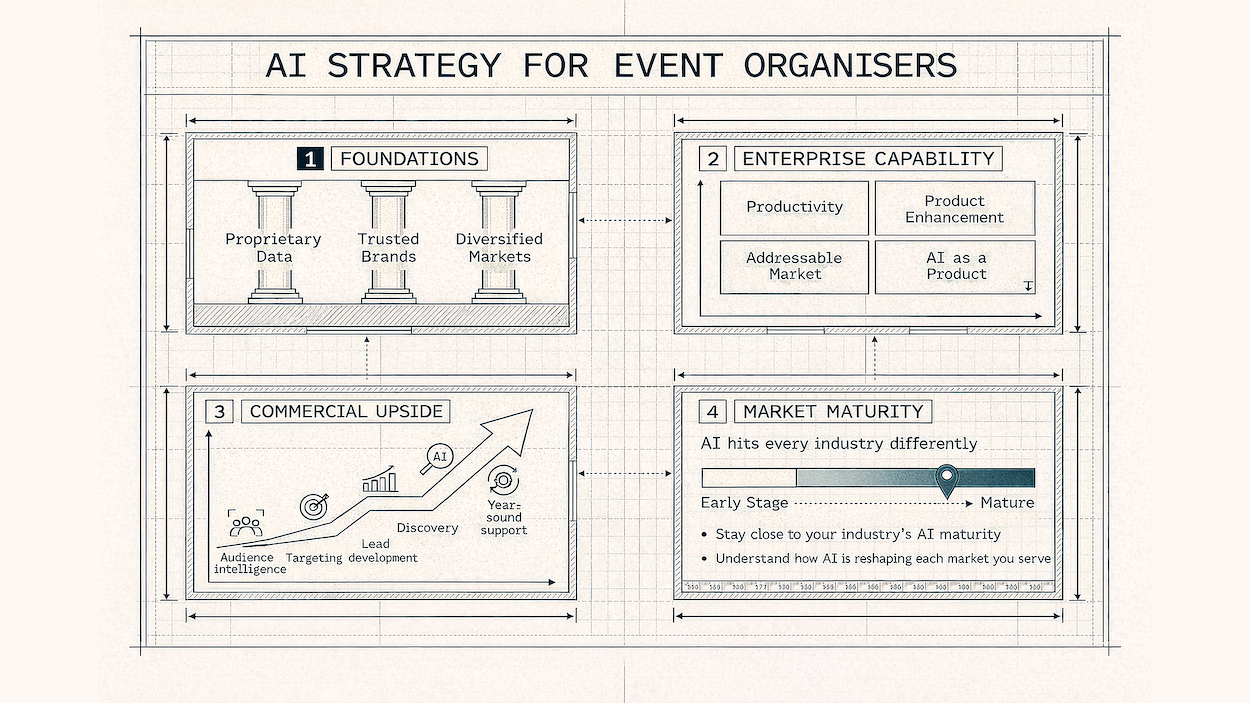
My one slide high-level take on Informa’s AI Strategy Framework. Feel free to share this with your team.
If you read their results presentation carefully, a clear picture emerges. Informa is building its AI case on foundations first, deployment second and monetisation third. I think that sequence matters. Too many organisers are still approaching AI from the opposite direction: starting with tools, pilots and prompts, then hoping value will follow. Informa’s presentation points to a harder truth: In exhibitions, the real AI battle will be won at the data layer, then at the workflow layer, and only then at the shiny-demo layer.
1. Foundations matter more than tools
The first lesson is about foundations. Informa lists five “core ingredients for AI acceleration”, but for exhibition organisers with less than £4bn turnover (including you), these can be distilled into three pillars:
Proprietary first-party data
AI becomes a strategic differentiator when it is trained on, or informed by, rich proprietary context at scale.
Trusted specialist brands
Organisers with established vertical brands have a clear advantage over those trying to bolt generic AI features onto weak propositions.
Diversified customer end-markets
AI is not reshaping every industry in the same way, so organisers need to understand how it is changing each market they serve. (more on this later)
The winners in AI will not be the ones who buy the most software licences or build the slickest internal demo. They will be the ones with the cleanest datasets, sharpest customer insights, strongest behavioural signals, clearest taxonomy, strongest first-party permissions and the tightest connection between audience data and commercial action.
If your CRM is patchy, your web signals are weak, and your data model is fragmented across teams and systems, AI may make the business look more modern, but it will not materially change anything. Only when those foundations are strong does AI start to reshape the business itself.
So if you want the shiny stuff, sort out the boring stuff first! The CRM, data architecture, and marketing ops work has to land before any AI pilot is worth running.
2. AI works best when it is treated as an enterprise capability
The second lesson is that Informa is treating AI as an enterprise capability rather than another digital tool or marketing gadget. It presents a clear framework for AI acceleration, grouping activity into four buckets:
Productivity
Product enhancement
Addressable market
AI as a product
That is a strong strategic framework because it asks four very sensible questions:
Where does AI save time/money?
Where does it improve an existing product?
Where does it expand revenue opportunity?
Where does it become a product in its own right?
Just as important is the breadth of use cases Informa highlights across live events, academic markets, digital services and internal functions. These include content and proposal creation, event planning, scheduling and proofing, research on speakers, leads and prospects, customer service automation, email personalisation, campaign management, targeted matchmaking, analytics, content curation, new business prospecting, discoverability audits and audience analysis.
That breadth matters. The highest-value AI use cases in exhibitions are rarely confined to one function. Better proposal generation improves sales productivity. Better audience analysis improves segmentation and exhibitor ROI. Better prospect research sharpens sponsorship conversations. Better internal analytics improve pricing, forecasting and retention management. Better discoverability improves content performance and lead generation.
AI is at its most useful when it helps the organiser make smarter decisions, faster, across multiple connected workflows. That is a much more valuable ambition than simply using it to generate copy a bit quicker. If you’d like to start making smarter decisions powered by AI today, you can try my Event Strategy Bot for a start.
3. The biggest upside is commercial
The third lesson is commercial. Informa links AI to expanding the addressable market and accessing broader marketing and business development budgets. The examples it gives include Audience Insights, Lead Insights, AI-driven prospecting, real-time summaries, podcasts and other new digital products. This is the point at which the AI story stops being an efficiency narrative and becomes a growth narrative.
Informa is effectively saying: AI can help us sell more value to more customers and dig into a broader set of budgets. That is exactly how organisers should be thinking about it. The real prize is not cheaper content production. It is more monetisable value around audience intelligence, targeting, lead development, discovery and year-round customer support. Talk to your marketing director about this.
For years, many organisers have relied on a familiar revenue mix: stand space, sponsorship, media, limited lead products and perhaps a few digital extensions. AI makes it possible to build a more intelligent layer on top of that model. But only if you’ve done your homework.
That layer might include better audience insights for exhibitors, smarter lead prioritisation, more relevant matchmaking, improved account targeting, richer post-event reporting, stronger year-round content discovery, and more useful decision support for customers before, during, and after the event. In other words, AI creates an opportunity for organisers to package intelligence as value rather than leaving it trapped within their own systems.
Bonus lesson: AI is not hitting every market in the same way
Later in the deck, Informa maps an independent assessment of AI impact by category. The key insight is that AI does not land in every industry in the same way.
In technology, workflow automation may drive some role consolidation. In food ingredients, AI improves traceability and supply-chain efficiency. In finance, it supports productivity across risk, compliance and customer operations. In marketing, it automates routine content and analytics work, pushing teams towards more strategic activity.
This is a subtle but important point. A finance event, a healthcare event, a food ingredients show, and a marketing festival should not all tell the same AI story. The content agenda, sponsor logic, product design and commercial message should be shaped by how AI is changing that specific industry.
Organisers who fully understand this early will have an edge. They will build stronger content programmes, more relevant propositions and better commercial narratives because they will be speaking to what is actually changing in their customers’ world, rather than repeating generic AI talking points.
TL;DR
First, AI advantage in exhibitions begins with clean first-party data, behavioural signals, trusted brands, and specialist context. (get your digital strategy sorted)
Second, real value comes when AI is woven into the operating model rather than parked in isolated tools. (Don’t start with tools, start from the strategy)
Third, the biggest upside is commercial: better products, stronger exhibitor outcomes, broader budgets and new intelligence-led revenue lines. (GTM, and/or new products, weave direct revenue into your plans)
Fourth, AI hits every industry differently; make sure your AI story fits with the maturity of your event’s industry. (always stay close to your industry)
That, to me, is how AI is becoming part of the organiser playbook, how events are built, how customers are understood, how value is packaged and how growth is unlocked.
In exhibitions, AI will not reward curiosity on its own; it will reward readiness. Clean data, strong workflows and clear commercial use cases will matter far more than enthusiasm. The winners will use AI to build a smarter organiser business. Everyone else will end up with a few shiny tools and very little commercial impact to show for them.
If you’d like to chat about your organisation’s AI strategy, you can contact me here.