AI Can Write the Email. It Cannot Shake Your Hand
A B2B buyer costs roughly $5 per click, $50 to become a lead, $500 to speak to, and $2,000+ to meet in person. That is not just a media plan. It is the price of attention. Same target account. Same buying committee. Often, the same named buyer and the same budget. Yet the commercial value of reaching them changes dramatically depending on the quality of interaction you can command. That spread is not random. It is the hierarchy we build businesses on.
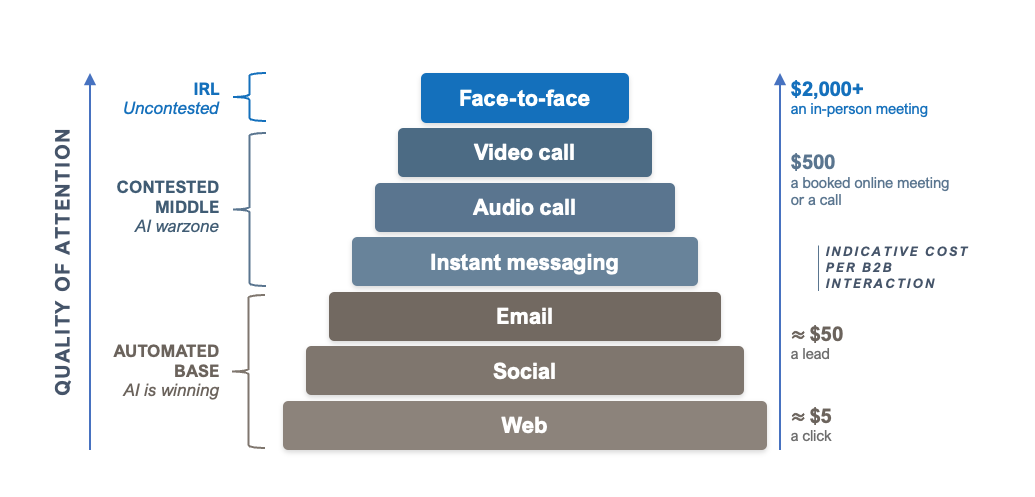
I mapped this hierarchy first, back in 2020, and (shamelessly) named it Onay’s Hierarchy of B2B Interaction. The idea is simple: every way two businesses can interact: meeting in person, a video call, an audio call, an instant message, an email, a social post, a website, can be ranked by a single variable, the quality of attention it commands. Click here to see the original article.
Naturally, face-to-face sits at the top, because it is the richest form of interaction: in person, spoken, real-time and unrecorded, it commands the undivided attention of both parties, and that is what lets two strangers build trust and solve a complex problem together in real time.
Everything beneath it is a thinner slice of the same thing: a video call loses a little signal, an audio call a little more, down through messaging and email to social and the website at the base: a one-way monologue that commands the least attention of all. Attention is the whole product, and our industry only (meaningfully) monetises the top of the pyramid (essential reading: The Attention Merchants by Tim Wu).
The pandemic once shoved the whole industry down that pyramid by one rung, and we spent 2020 mourning what we lost on the way down. Today, AI is doing something stranger. It attacks from the bottom up and, as it climbs, splits the hierarchy into three bands.
The Automated Base: where the humans are retreating
(web, social, email)
Start at the bottom, because that is where the change is most dramatic. Your website has a chatbot answering its visitors in plain language. Your social is scheduled, and increasingly written, and sometimes even ‘liked’ by a model. Your email is drafted by one and is now increasingly being read by one too, machine-to-machine, with no humans in front of the screens.
There is a fringe idea called the Dead Internet Theory: the claim that most of what is now online is no longer written by people but generated by machines talking to machines. As a conspiracy, it might be overcooked, but as a description of the base of this pyramid, it is increasingly becoming the norm.
When one model writes a post, and another summarises it, humans never see the actual content. Instead of reading the web, people increasingly rely on AI summaries of other machine-generated content. When both writer and reader are machines, human attention at this level is essentially absent.
You need to move your business up the pyramid; most buyers already have.
The Contested Middle: the new battleground
(instant messaging, audio and video calls)
The middle is an AI warzone hollowing out from both ends. From below, the squeeze is relentless. The first thing that answers you is a chatbot, not a person. The online meeting (let’s face it… a call) you used to attend, you now send a notetaker to, and so does everyone else, until the summary is the only thing that survives the meeting, almost removing any reason for a human to be present at all.
From within, trust is leaking out. As synthetic voice and video become cheap, familiar faces and known voices are no longer reliable signals on their own. The point is not that every video or audio call is now suspect. It is that mediated interaction has lost some of its old evidential power. Seeing is no longer believing, and hearing is even worse.
And yet the middle has not collapsed, because buyers keep doing something revealing. Gartner’s latest B2B buyer research captures the contradiction perfectly: 45% of buyers used GenAI in a recent purchase, 67% prefer a sales rep-free buying experience, and 70% prefer a completely digital, self-service journey. But 69% still want to validate AI-generated insights with a sales rep. Buyers want autonomy, but they still need confidence, and that is reserved for humans.
That is the new role of the middle. It is no longer just about information being transferred. AI can do that. It is where uncertainty is reduced, risk is challenged, assumptions are tested, and a buyer decides whether the thing they have read, watched, or been told can actually be trusted.
IRL: the one thing the machine cannot do
(hint: it’s face-to-face)
The internet handed us an acronym long before we understood why we would need it: IRL (in real life), a scrap of 1990s chatroom slang now logged in the dictionary. For three decades, it was a throwaway tag, the thing you did once you logged off. Today, AI is turning it into the most valuable phrase in B2B.
IRL, it turns out, is the one tier AI cannot colonise. The value of face-to-face was never the information. It was the signal. Getting on a plane or into a taxi to be present in person is a costly, unfakeable act of commitment. The instant everything beneath it can be automated or faked, the unfakeable thing becomes the scarce thing, and scarcity is pricing power.
AI, by making the bottom tiers infinite, mineable, automated, and synthetic, isolates the apex and puts it in the spotlight. The three jobs face-to-face does better than anything else are:
• building trust from a standing start,
• solving complex problems,
• reaching a solution at the speed that only undivided attention allows.
You do not have to take my word for it. As I traced in a recent piece on private equity in events, some of the world’s most sophisticated investors have spent billions recently on a wave of take-privates and megadeals. The apex is being underwritten by people who price risk for a living, and they are betting on the room.
But this does not mean every event wins...
AI does not protect mediocre face-to-face. It exposes it. A generic room, a weak audience, poor curation, thin content, irrelevant networking, and accidental meetings do not become more valuable simply because they happen in real life. If anything, the bar rises.
The premium shifts to events that can assemble the right people, create trust quickly, curate meaningful conversations, surface real buying intent, and help complex buying groups move forward. If you're not certain your event clears that bar, that is exactly what an event strategy session is built to establish.
When face-to-face becomes the scarce layer of B2B interaction, the quality of that interaction matters more. The premium shifts to events that can assemble the right people, create trust quickly, curate meaningful conversations, surface real buying intent, and help complex buying groups move forward.
The product has never been floor space. It is not even attendance anymore. It is intent-verified, high-quality attention in a room where interaction is difficult to fake, automate, or ignore.
AI still cannot shake your hand
I have argued for years that our industry is in the handshakes business, its job-to-be-done being creating the trusted human relationship that closes the deal.
As AI digests everything beneath it, the handshake is once again crowned the most valuable, most defensible, most expensive thing we sell.
If you’d like to discuss what this means for your business, send me an email, or book some time for us to have a chat.
Dr. Barış Onay